Understanding Trauma: Types, Symptoms, and Pathways to Healing
Trauma is one of those words that carries enormous weight — and yet it's frequently misunderstood. Many people wonder whether what they've experienced "counts" as trauma, or whether their reactions are normal. The short answer: your experience is valid, your nervous system responded exactly as it was designed to, and healing is genuinely possible. This guide walks through what trauma actually is, how it manifests, and what recovery can look like.
What Is Trauma? Moving Beyond the Myth of "Big Events"
Trauma is not defined by the size of an event — it's defined by the impact that event has on your nervous system and your sense of safety in the world. A car accident, a childhood of emotional neglect, a medical procedure, or years of microaggressions can all produce genuine traumatic responses. What matters is not what happened, but what happened inside you as a result.
Psychiatrist Bessel van der Kolk, author of The Body Keeps the Score, describes trauma as anything that overwhelms a person's capacity to cope. That framing is important because it removes the hierarchy of suffering. Your experience doesn't need to compare to someone else's to be real.
Trauma can be a single incident, a prolonged pattern, or a wound that began before you had words for it. What all these experiences share is that they leave a mark — on your thoughts, your emotions, your body, and your relationships. Recognizing this is often the first step toward understanding yourself more clearly.
The Main Types of Trauma
Trauma falls into several distinct categories, and knowing which type resonates with your experience can help you find the right support. The four primary types are acute, chronic, complex, and developmental trauma — each with its own texture and set of challenges.
- Acute trauma stems from a single, time-limited event: a natural disaster, a violent assault, a sudden loss. It has a clear beginning and end, though its effects can linger for months or years.
- Chronic trauma results from repeated or prolonged exposure to distressing events — domestic violence, ongoing abuse, or living in a conflict zone. The nervous system never fully gets to rest and recover.
- Complex trauma (often called C-PTSD) typically involves repeated interpersonal harm, especially in contexts where escape felt impossible — like abusive relationships, trafficking, or institutional abuse. It tends to affect identity, emotional regulation, and the ability to trust others.
- Developmental trauma occurs during childhood, when the brain and nervous system are still forming. Adverse Childhood Experiences (ACEs) — including abuse, neglect, household dysfunction, and exposure to violence — are among the most studied forms. Research consistently shows that higher ACE scores correlate with increased risk of mental and physical health challenges in adulthood.
These categories aren't rigid boxes. Many people carry more than one type, and the boundaries between them often blur.
How Trauma Shows Up: Recognizing the Symptoms
Trauma symptoms span emotional, cognitive, physical, and behavioral dimensions — and they don't always look the way people expect. Recognizing them is not about labeling yourself, but about understanding what your system is trying to communicate.
Emotional symptoms can include persistent fear, shame, guilt, numbness, sudden grief, or rage that feels disproportionate to the situation. Many survivors describe feeling disconnected from themselves or from others — a phenomenon called dissociation.
Cognitively, trauma often distorts the way people think about themselves and the world. Beliefs like "I am broken," "nowhere is safe," or "I can't trust anyone" are common. Intrusive memories, nightmares, and difficulty concentrating are also hallmarks of traumatic stress.
The somatic symptoms — physical sensations tied to trauma — are frequently overlooked. Chronic tension in the shoulders or jaw, unexplained digestive issues, fatigue, headaches, and hypervigilance (a constant scanning of the environment for threat) are all ways the body holds what the mind hasn't fully processed.
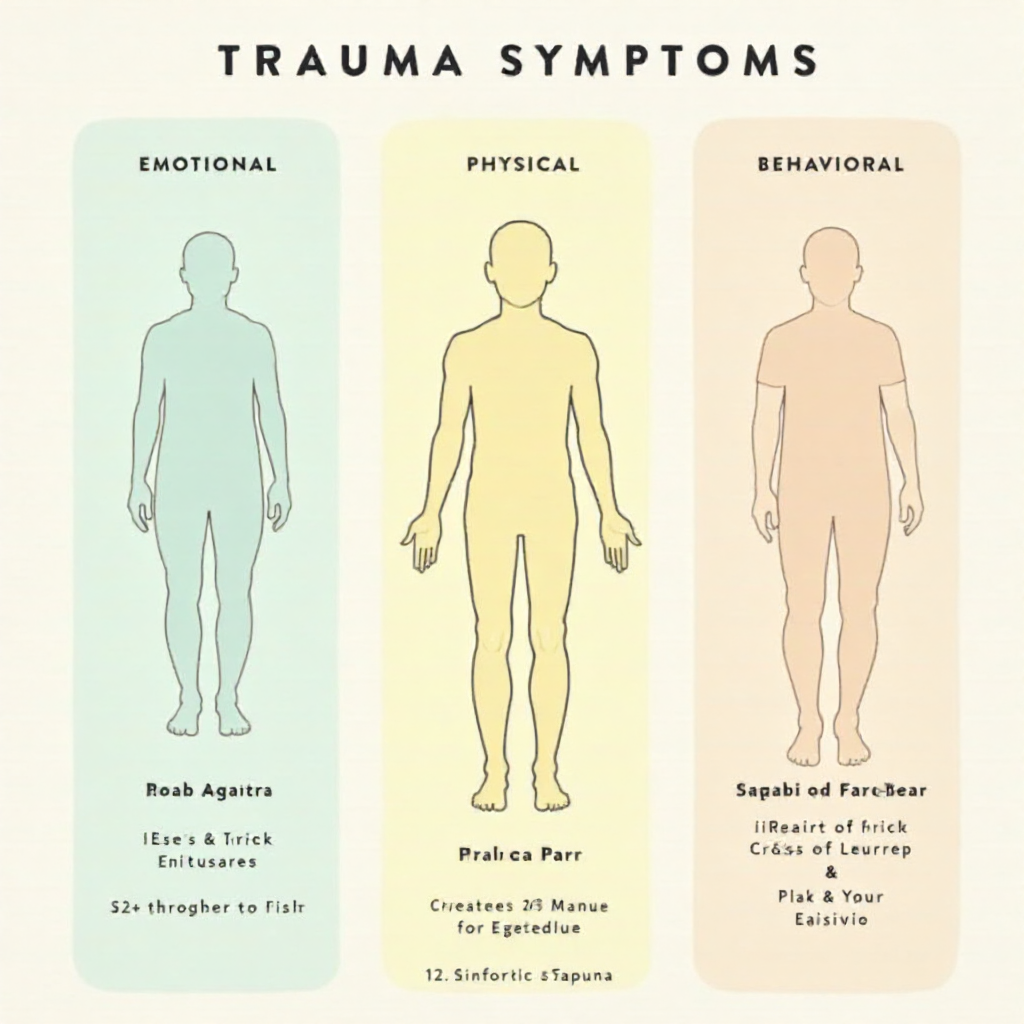
Behaviorally, trauma can manifest as avoidance of people, places, or conversations that feel triggering. Some survivors withdraw; others become people-pleasers. Substance use, self-isolation, and difficulty maintaining relationships are also common — not character flaws, but adaptations the nervous system developed to manage overwhelming experience.
The Trauma Response: Why Your Body Reacts the Way It Does
The fight, flight, freeze, and fawn responses are your nervous system's survival toolkit — not signs of weakness or dysfunction. When the brain perceives danger, it activates these automatic responses before the thinking mind has a chance to weigh in.
Nervous system dysregulation is at the heart of most trauma symptoms. The autonomic nervous system — which governs heart rate, breathing, digestion, and more — gets stuck in a state of high alert or complete shutdown. This is why trauma survivors often describe feeling either wired and anxious or completely flat and disconnected.
The four primary responses work like this:
- Fight: mobilizing to confront the threat — anger, defensiveness, aggression
- Flight: moving away from the threat — anxiety, restlessness, avoidance
- Freeze: immobilizing when neither fight nor flight seems viable — numbness, dissociation, feeling "stuck"
- Fawn: appeasing the threat to stay safe — excessive people-pleasing, difficulty saying no, suppressing one's own needs
Understanding that these responses were once protective — and that they made sense in the context they developed — is one of the most compassionate things you can offer yourself. Your body wasn't broken. It was trying to keep you alive.
The Impact of Unresolved Trauma Over Time
When trauma goes unaddressed, its effects tend to ripple outward into nearly every area of life. This isn't inevitable, and it doesn't mean you're beyond help — but it does mean that ignoring trauma rarely makes it smaller.
Relational patterns are often the first place unresolved trauma becomes visible. Difficulty trusting partners, fear of abandonment, cycles of conflict or withdrawal, and challenges with intimacy can all trace back to early or repeated traumatic experiences. The nervous system learned certain rules about relationships, and it applies them even when the original threat is long gone.
Self-worth is another casualty. Survivors of chronic or developmental trauma frequently internalize shame — a deep, often wordless sense that something is fundamentally wrong with them. This can drive perfectionism, self-sabotage, and difficulty accepting care from others.
Physical health is also affected. The CDC's research on Adverse Childhood Experiences has documented links between high ACE scores and increased rates of heart disease, autoimmune conditions, chronic pain, and other physical health challenges — a direct result of prolonged nervous system dysregulation and chronic stress.
Pathways to Healing: Approaches That Support Recovery
Healing from trauma is possible — and there are multiple evidence-supported pathways, not just one right way. The most effective approaches tend to address both the mind and the body, recognizing that trauma is stored somatically as much as psychologically.
Trauma-informed therapy is a broad term for therapeutic approaches that understand how trauma shapes the nervous system and behavior. Modalities like EMDR (Eye Movement Desensitization and Reprocessing), somatic experiencing, internal family systems (IFS), and trauma-focused cognitive behavioral therapy have strong track records. A trauma-informed therapist won't just talk about the past — they'll help your nervous system learn that the present is safe.
Somatic practices — body-based approaches like breathwork, yoga, movement, and mindfulness — can be powerful complements to therapy. Because trauma lives in the body, healing often requires working with the body directly. Even simple practices like slow diaphragmatic breathing can begin to shift the nervous system out of a state of chronic alarm.
Community and connection matter enormously. Research on resilience and post-traumatic growth consistently highlights the role of safe relationships in recovery. Survivor support groups, peer communities, and trusted relationships all contribute to healing in ways that individual therapy alone may not fully provide.
Self-compassion is not a soft add-on — it's a clinical tool. Studies by researcher Kristin Neff show that self-compassion practices reduce shame and self-criticism, both of which are central barriers to trauma recovery. Treating yourself with the same warmth you'd offer a struggling friend is genuinely therapeutic work.
Taking the First Step Toward Healing
The first step toward healing doesn't have to be dramatic. It can be as simple as acknowledging that what you experienced affected you — and that you deserve support. That recognition alone is significant.
Healing from trauma is nonlinear. There will be days when you feel like you've moved backward, and that's a normal part of the process, not a sign of failure. The nervous system heals in spirals, not straight lines. Progress often looks like: a moment of noticing a trigger without being consumed by it, a conversation you could finally have, a night of sleep that felt genuinely restful.
If you're not sure where to start, consider reaching out to a therapist who identifies as trauma-informed. The SAMHSA National Helpline offers free, confidential referrals to mental health and support services. You don't have to have everything figured out before you reach out. Asking for help is not weakness — it's the beginning of something.
You are not broken. You are a person whose nervous system learned to protect you under difficult circumstances. With the right support, those protective patterns can soften, and life can feel different than it does right now.
Frequently Asked Questions
Can trauma occur without a single dramatic event?
Yes. Trauma can result from ongoing experiences — emotional neglect, chronic stress, relational harm, or systemic oppression — rather than one identifiable moment. What matters is the lasting impact on your nervous system and sense of safety, not the "size" of what happened.
What is the difference between trauma and PTSD?
Trauma is the broad term for a wound caused by overwhelming experience. PTSD (Post-Traumatic Stress Disorder) is a specific clinical diagnosis that can develop after trauma, characterized by intrusive memories, avoidance, negative mood changes, and hyperarousal lasting more than a month. Not everyone who experiences trauma develops PTSD, but all PTSD involves trauma.
How long does trauma healing take?
There is no fixed timeline. Healing depends on the type and duration of trauma, the support available, individual nervous system differences, and the approaches used. Some people notice meaningful shifts within months; for others, healing unfolds over years. The goal isn't to "get over" trauma on a schedule — it's to integrate the experience so it no longer runs your life.
Is it possible to heal from childhood trauma as an adult?
Absolutely. The brain retains neuroplasticity throughout life, which means new patterns can form at any age. Developmental trauma can be particularly complex to work through, but many adults find significant relief and transformation through trauma-informed therapy and consistent, compassionate support.
How do I know if I need professional help for trauma?
If your experiences are interfering with your relationships, work, physical health, or daily functioning — or if you find yourself using coping strategies that feel out of control — reaching out to a professional is a reasonable and wise step. You don't need to be in crisis to deserve support. Feeling stuck, numb, or like something is "off" is enough of a reason to seek help.